
Heavy Equipment Transport: Lowboy, Step Deck, and RGN Hauling Nationwide
We arrange heavy equipment transport across the continental United States. Excavators, dozers, tractors, and work trucks ride on lowboy, step deck, and RGN trailers. Your price locks when you book.
- 50,000+ Vehicles Shipped
- A+ BBB Rating
- 10+ Years Shipping Cars
Instant Transport Quote
Enter both locations. Have the machine's make, model, size, and weight ready.
Or talk to a real person: 855.422.4141
-
Price Lock Guarantee Your quote is final. Guaranteed.
-
Live Agents Standing By Real people from booking to delivery.
-
Fully Vetted Carriers FMCSA and DOT compliant.
-
Fully Bonded & Insured Bumper to bumper protection.




Read what customers say on our auto transport reviews page.
Heavy Equipment Transport, in Short
Heavy equipment transport moves machines like excavators, dozers, tractors, and dump trucks on a lowboy, step deck, or RGN trailer. The trailer depends on the machine's height, its weight, and how it loads. Every load is quoted on its own, and your price locks when you book.
Most loads within legal size limits are picked up within a 1 to 5 day window. On trips up to 2,500 miles, they spend 2 to 10 days on the truck. Loads that need permits take longer.
Who Moves Your Equipment
We are a licensed broker, not a carrier. MC-796224 and USDOT 2336907. We do not own trucks or employ drivers. We vet, book, and manage the carriers who do, and we stay on the shipment until it is delivered. You can check both numbers in the FMCSA SAFER system.
For heavy equipment, we book a carrier that runs the trailer your machine needs. On an oversize load, that carrier holds the permits for your route. It runs with escort vehicles when the route calls for them.
Before a carrier gets your load, we check its operating authority, its insurance on file, and its safety record. The carriers we book keep $1,000,000 in liability and $100,000 to $1,000,000 in cargo coverage.
In business since 2010, with more than 50,000 vehicles shipped. Family owned, A+ with the BBB, and on the Inc. 5000 list. When you call, a real person picks up.

Lowboy, Step Deck, and RGN Trailers
The right trailer depends on how tall the machine is, how much it weighs, and how it loads. We match the trailer to your machine's weight, dimensions, and ground clearance.
Which Trailer Does Your Equipment Need?
-
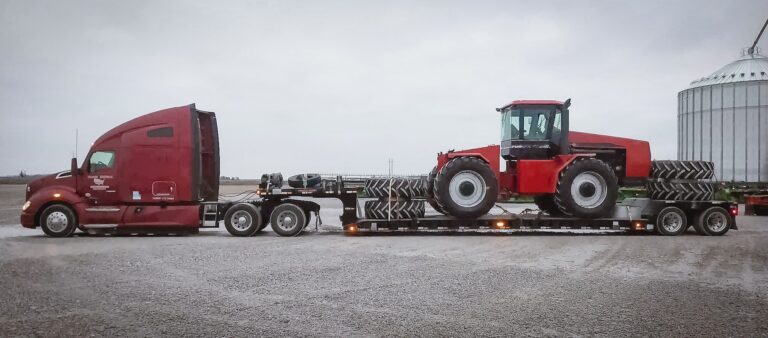
Lowboy and RGN Trailers
A lowboy's deck sits 18 to 24 inches off the ground, lower than a step deck or flatbed. It keeps tall, heavy machines like large excavators, dozers, and cranes low for bridges and overpasses. An RGN is a lowboy with a front that detaches. The deck then becomes a ramp, so machines drive or winch straight on.
-
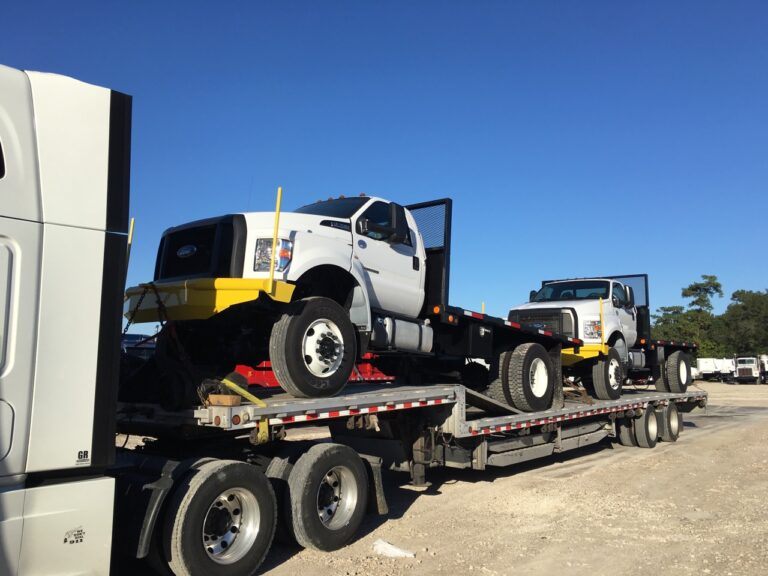
Step Deck Trailer
Also called a drop deck. The deck steps down behind the truck, so the load rides lower than on a flatbed. It fits loaders, forklifts, farm equipment, and box trucks that are too tall for a flatbed.
Lowboy vs Step Deck vs RGN
| Trailer | What sets it apart | Best for | Common loads |
|---|---|---|---|
| Lowboy | A low deck, 18 to 24 inches off the ground | The tallest and heaviest machines | Large excavators, dozers, cranes |
| Step deck | The deck steps down behind the truck, lower than a flatbed | Loads too tall for a flatbed that do not need a lowboy | Loaders, forklifts, farm equipment, box trucks |
| RGN | A lowboy whose front detaches, so the deck becomes a ramp | Tracked machines and equipment that does not run | Excavators, dozers, farm tractors |
Not sure which trailer fits? Send the make, model, and size, and we book a carrier with the right trailer.
Heavy Equipment We Ship
We arrange transport for construction, farm, and industrial machines, plus the commercial trucks that work beside them.
Construction Equipment
Excavators, backhoes, bulldozers, graders, scrapers, pavers, wheel loaders, and skid steers.
Cranes and Lifts
Cranes, boom lifts, aerial work platforms, and telehandlers.
Farm Equipment
Farm tractors, combines, harvesters, planters, and large tillage equipment.
Industrial Equipment
Forklifts, generators, pumps, heavy press equipment, and oversized storage tanks.
Oilfield Equipment
Drilling rigs and oilfield equipment. Our Texas page covers heavy haul work there, including the Permian Basin.
Commercial Trucks
Dump trucks, box trucks, cement mixers, buses, boom trucks, and fire trucks.
Dump Truck and Box Truck Transport
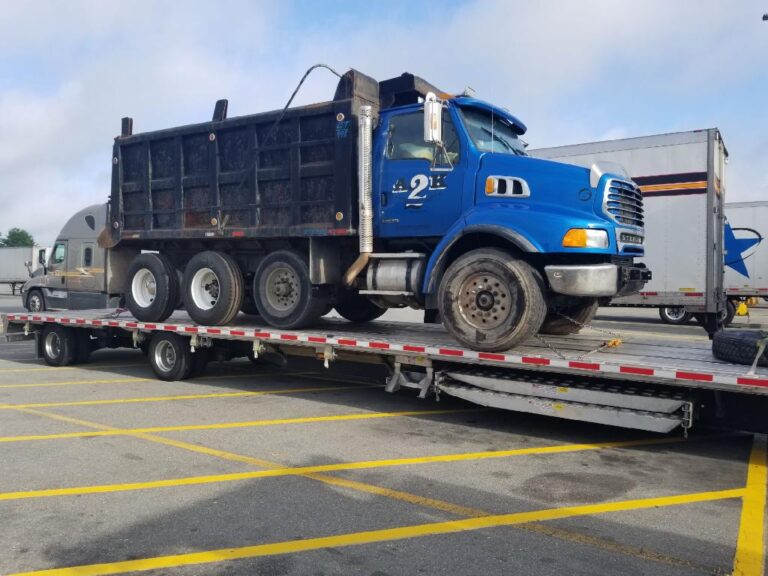
We arrange transport for dump trucks, box trucks, and fleet vehicles. Construction firms, dealerships, and owners use it to move trucks across the country.
We check each truck's weight and height to pick the trailer, often a step deck or a lowboy. Shipping keeps long highway miles and road wear off the truck.
How Much Does Heavy Equipment Transport Cost?
Every heavy equipment load is quoted on its own. We do not publish a flat rate. The price turns on the machine, the trailer, the permits, and the miles. Send the specs and both locations, and we come back with a price that locks when you book.
Your quote covers the full scope of the move, based on the specs you send. There are no hidden fees.
What Sets Your Heavy Haul Price
- Size and weight. They decide the trailer and whether the load needs oversize or overweight permits.
- Permits. An oversize or overweight load needs a permit from each state where it is over the limits.
- Escorts. Very wide loads need escort vehicles in many states, and the widest loads need two.
- Distance and route. Longer trips cost more in total. A permit can also set the exact route the truck must run.
- Loading. A machine that does not run needs a winch, and often an RGN. Tell us when you ask for a quote.
- Your dates. A flexible pickup window gives us more carriers to choose from.
What to Send for a Quote
Make and Model
The year, make, and model, or the spec sheet if you have it.
Size and Weight
Length, width, height, and weight, with attachments on.
Running or Not
Whether it starts, drives, and steers on its own.
Sites and Dates
Both addresses, anything tight about getting a truck in, and your first available date.
Have the specs handy? One call or a quick form gets you a quote. Your rate locks when you book.
Does Your Equipment Need an Oversize Permit?
Yes, if the loaded truck runs over legal size or weight. That means wider than 8.5 feet or taller than the state's height limit. It also means longer than the state allows, or over the weight limit for the truck or any axle. Each state where the load is over the limits issues its own permit. Carriers in our network handle the permits, route surveys, and escort vehicles.
Legal Size and Weight Limits
| Limit | The rule | What it means for your load |
|---|---|---|
| Width | 8.5 feet (102 inches) on interstates and other major truck routes | A wider load needs an oversize permit. |
| Height | No federal limit. Most states set 13 feet 6 inches to 14 feet. | The trailer deck counts, so a lower deck leaves more room for the machine. |
| Gross weight | 80,000 pounds on the Interstate System | A heavier load needs an overweight permit. |
| Axle weight | 20,000 pounds on a single axle, 34,000 pounds on a tandem | The weight on each axle counts too, not just the total. |
Sources: FHWA and 23 CFR 658. Some roads and bridges carry lower posted limits.
How Oversize Permits Work
The federal government does not issue oversize or overweight permits. Each state does, for its own roads. A load that is over the limits in four states needs a permit from each of them. City or county roads can need their own.
A permit sets the route the truck must run and the rules it must follow. Many states hold wide loads to daylight hours. Many also keep them off the road on major holidays and in bad weather. Some, like Kansas and Nebraska, also block rush hour in their biggest metro areas.
Escort Vehicles and Pilot Cars
Escort rules change from state to state and grow with the load's width. In Nebraska, a load 12 to 16 feet wide needs one escort vehicle, and a wider load needs two. North Dakota requires pilot cars once a load passes 16 feet wide. On two-lane highways, one leads and one follows. On four-lane divided highways, one follows.
Carriers in our network book the escorts and plan the travel windows. We coordinate the move and keep you posted. Some of our state pages list that state's escort and travel rules.
How Long Does Heavy Equipment Transport Take?
Plan on a 1 to 5 day pickup window, then 2 to 10 days on the truck. That holds for a load within legal size limits on trips up to 2,500 miles. Longer trips take longer. A load that needs permits takes longer too. It waits on permits, and many states let wide loads move in daylight only.
From Booking to Delivery
| Stage | How long | What happens |
|---|---|---|
| Booking | 3 to 7 days ahead | Time to line up a carrier with the right trailer for your machine. |
| Booking, with permits | Up to 2 weeks ahead | Time for the carrier to get each state's permits. |
| Pickup window | Usually 1 to 5 days | The driver calls ahead to set a time at the site. |
| Under 1,000 miles | 2 to 3 days | Time on the truck for a load within legal limits. |
| 1,000 to 1,750 miles | 4 to 6 days | Time on the truck for a load within legal limits. |
| 1,750 to 2,500 miles | 7 to 10 days | Time on the truck for a load within legal limits. |
| Over 2,500 miles, or permitted | Set by the route | You get a timeline built for your route. |
These are typical windows, not promised dates. A load within legal limits needs no state permits, so it books and moves faster. Weather holds, travel limits, and permit waits can add days.
How Is Heavy Equipment Secured for Transport?
Federal rules set how a machine rides. Attachments go down, articulated machines are locked so they cannot pivot, and at least four tie-downs hold the machine. The carrier's cargo insurance covers your machine from pickup to delivery, up to its policy limit.
Federal Tie-Down Rules for Heavy Equipment
Under 49 CFR 393.130, these rules apply to machines on wheels or tracks that weigh 10,000 pounds or more. Think loaders, bulldozers, tractors, and power shovels.
- Attachments like hydraulic shovels are lowered all the way and secured.
- Articulated machines are locked so they cannot pivot in transit.
- At least four tie-downs hold the machine against side, forward, rear, and upward movement.
- Tie-downs attach as close as practical to the front and rear, or at the machine's own tie-down points.
A separate rule, 49 CFR 393.106, sets how strong the tie-downs must be. Their combined working load limit must be at least half the machine's weight. A chain from the trailer to the machine counts at only half its rating. Run that way, the chain ratings must add up to the machine's full weight.
What Keeps Your Equipment Safe
Vetted Carriers
We check each carrier's operating authority, insurance on file, and safety record before it gets your load.
Cargo Insurance
Carriers we book keep $1,000,000 in liability and $100,000 to $1,000,000 in cargo coverage. Limits vary by carrier.
The Right Trailer
We match the trailer to the machine's weight, size, and ground clearance.
Bill of Lading
You and the driver record the machine's condition at pickup, then check it again at delivery.
Check the Cargo Limit Against Your Machine's Value
Ask us for the carrier's insurance certificate before dispatch. Check the cargo limit and deductible against what your machine is worth. If it is worth more, tell us before you book. Your own equipment policy may also cover it in transit, so call your agent.
If Your Equipment Arrives Damaged
Mark the damage on the bill of lading while the driver is there, and get the driver's signature. Take clear photos. Then call us and the carrier right away. The carrier's insurer can deny a claim for damage that was not noted at delivery.
Why Haul Heavy Equipment Instead of Driving It?
Most heavy machines are built for the job site, not the highway. For a long move, a trailer wins.
Less Wear on the Machine
Highway miles add wear, hours, and upkeep. Shipping keeps them off and protects resale value.
Built for the Site
Dozers, crawler cranes, and most loaders are not designed for highway travel.
Faster Across State Lines
A truck covers a long distance much faster than a machine can drive it.
Crews Stay on the Job
Your operators keep working instead of spending days moving equipment.
How Heavy Equipment Transport Works
Every load runs on the same five steps, from quote to delivery. Our how it works page covers each one.
Quote
Send the machine's make, model, size, weight, both locations, and your first available date. The price locks when you book.
Match
We book a vetted carrier with the right trailer. On an oversize load, the carrier gets the permits and books any escorts.
Pickup
The driver calls ahead to set a time. You walk the machine together and both sign the bill of lading.
Transit
The load rides to its destination while the driver and our dispatch team keep you updated.
Delivery
The driver calls ahead. You inspect the machine, note any damage on the bill of lading, and sign.
How to Prepare Heavy Equipment for Transport
A little prep before pickup keeps the load moving and makes inspection quick. Work down this list.
Measure and Weigh It
Length, width, height, and weight with attachments on. Those numbers pick the trailer and the permits.
Clean It
Knock off mud and loose debris so nothing blows off on the highway and damage shows at inspection.
Photograph It
Every side, the cab, the tracks or tires, and the hour meter, with the date showing.
Secure Loose Parts
Remove tools, chains, and loose items from the cab and deck. Latch every cover.
Flag Leaks and Faults
Tell the driver about leaks. Tell us if it does not run, so the carrier brings a winch.
Plan the Site
Tell us about tight gates, soft ground, low wires, or set hours for trucks at either end.
Have the Keys Ready
And tell us who meets the driver at pickup and at delivery.
Heavy Equipment Transport by State
We arrange heavy equipment transport across the continental United States. Our state pages cover heavy haul work in each state, and some list that state's permit and travel rules.
State Pages With Heavy Haul Details
Every state has its own page. Find yours on our ship by state page.
Related Services
Heavy Equipment Transport Questions
Quick answers before you book. Our auto transport FAQ page covers the rest.
What is heavy equipment transport?
Moving construction, farm, and industrial machines, plus commercial trucks, on a trailer built for their size and weight. Most loads ride on a lowboy, step deck, or RGN trailer.
How much does heavy equipment transport cost?
Every load is quoted on its own. The price depends on the machine's size and weight, the trailer, any permits and escorts, the distance, and your dates. Send the specs and both locations, and your price locks when you book.
What is a lowboy trailer?
A trailer with a very low deck, 18 to 24 inches off the ground. It carries tall, heavy machines like large excavators, dozers, and cranes, and keeps them low for bridges and overpasses.
What is the difference between a lowboy, a step deck, and an RGN?
A lowboy has the lowest deck and carries the tallest and heaviest loads. An RGN is a lowboy whose front detaches, so machines drive or winch straight on. A step deck steps down behind the truck and fits loads too tall for a flatbed.
When does heavy equipment need an oversize permit?
When the loaded truck is wider than 8.5 feet, taller than the state's limit, or longer than the state allows. A load over 80,000 pounds, or over an axle limit, needs an overweight permit. Most states set height limits between 13 feet 6 inches and 14 feet.
Who handles permits and escort vehicles?
Carriers in our network get the oversize and overweight permits for each state that requires one. They book escort vehicles when a state requires them. We coordinate the move and keep you posted.
How long does heavy equipment transport take?
Most loads within legal size limits are picked up within a 1 to 5 day window. Under 1,000 miles, they take 2 to 3 days on the truck. A trip of 1,750 to 2,500 miles takes 7 to 10 days. Longer trips and permitted loads get a timeline built for the route.
How far ahead should I book heavy equipment transport?
Book at least 3 to 7 days ahead. For an oversize load, book up to two weeks ahead so the carrier has time to get every state's permits.
How is heavy equipment secured on the trailer?
These federal rules cover machines of 10,000 pounds or more. Attachments are lowered and secured, and articulated machines are locked so they cannot pivot. At least four tie-downs, set near the front and rear or at the machine's tie-down points, hold it in place.
Is my equipment insured during transport?
Yes. Carriers we book keep $1,000,000 in liability and $100,000 to $1,000,000 in cargo coverage, and we verify it before dispatch. Limits vary by carrier, so ask for the certificate and check the limit against your machine's value.
Can you arrange transport for equipment that does not run?
Yes. Tell us when you ask for a quote. A machine that does not run usually goes on an RGN. The detached front forms a ramp, and the machine is winched up it.
Do you ship dump trucks and box trucks?
Yes. We arrange transport for dump trucks, box trucks, cement mixers, buses, boom trucks, and fire trucks. They often ride on a step deck or a lowboy, based on the truck's weight and height.
Is Number 1 Auto Transport a lowboy carrier or a broker?
We are a licensed broker, not a carrier. MC-796224 and USDOT 2336907. We do not own trucks or employ drivers. We vet, book, and manage the carriers who do, and we stay on the shipment until it is delivered.
What payment methods do you accept for heavy equipment transport?
We accept all major credit cards, bank wire transfers, and certified checks.
Get Your Heavy Equipment Transport Quote
Enter both locations in the form at the top of this page, or call with the machine's specs. Read what customers say on our auto transport reviews page, then lock your rate.
Number 1 Auto Transport
Phone: 855.422.4141
Hours: Monday to Friday 8am to 8pm ET, Saturday 9am to 5pm ET
MC-796224 | USDOT 2336907
Number 1 Auto Transport is a licensed and bonded auto transport broker, not a motor carrier. We arrange transportation with vetted, FMCSA-authorized carriers who hold active cargo insurance. Transit times shown are typical ranges, not promised dates. Your locked rate is confirmed at booking.